Getting this decision wrong is expensive. Not just in money but in time, rework and projects that stall because a supplier couldn’t deliver what they quoted. Most buyers only discover a supplier’s real capabilities after the first order falls short. By then, the damage is already done.
This checklist is written for procurement managers, engineers and operations leads who are actively comparing suppliers and want a practical way to do it properly before committing.
Why Supplier Selection Matters More Than You Think
A missed deadline on a machined component can hold up an entire production line. Scrap caused by a supplier working outside agreed tolerances adds cost that rarely gets recovered. And once you’re locked into a supplier mid-project, switching becomes its own problem.
The risks aren’t just operational. A poor supplier choice can delay product launches, damage your own client relationships and create supply chain gaps that take months to close. Due diligence at the start costs a few hours. Getting it wrong costs far more.
The Buyer’s Checklist
Most guides on this topic stop at certifications. Here’s what actually separates reliable suppliers from ones that look good on paper.
Capability Match
Start here. Does the supplier’s equipment match what your parts actually need? Ask specifically about materials they work with regularly, the tolerances they hold in production (not just in theory) and whether their machinery can handle your geometry and volumes. A supplier offering precision engineering services should be able to walk you through their workshop floor without hesitation.
Certifications and Quality Systems
ISO 9001 is the baseline. For aerospace, defence or medical work, you’ll want additional accreditations. Ask how quality is managed day-to-day, not just what’s on the wall. A certificate without a working quality management process behind it means very little.
Industry Experience
Relevant sector experience matters because different industries have different risk tolerances. A supplier that machines automotive components every day thinks differently about traceability and repeatability than one that doesn’t. Ask for examples of similar work, not just a general capabilities list.
Tolerances and Inspection
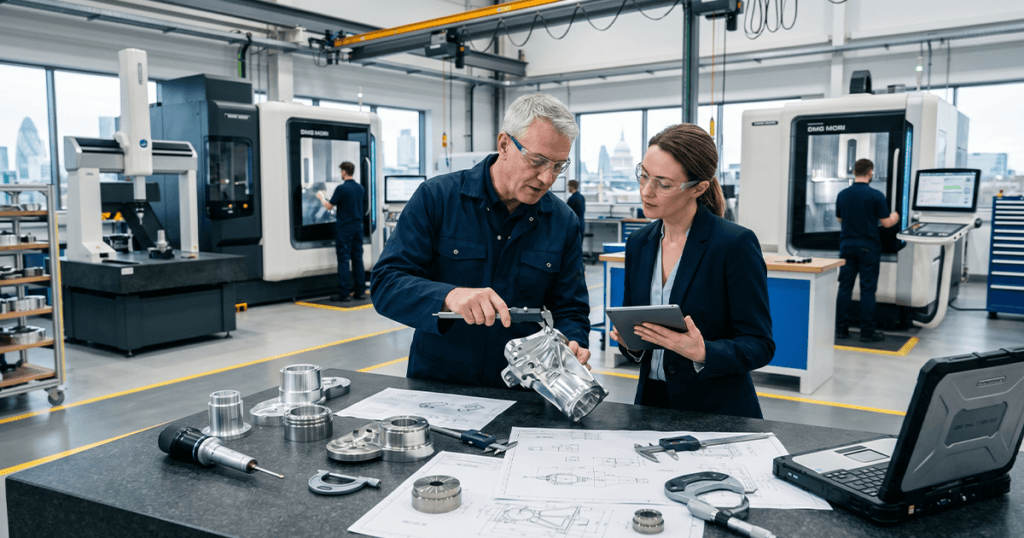
This is where a lot of buyers don’t go deep enough. Ask what inspection equipment they have on-site, how they verify against drawing requirements and what their first article process looks like. Understanding what the first article inspection actually involves will help you ask sharper questions here and spot suppliers who are vague on the details.
Their quality inspection services should be systematic, documented and available for you to review. If they can’t show you a sample inspection report, that’s worth noting.
Production Capacity and Lead Times
Can they actually deliver within your timeline, at your volume? Ask about typical lead times for your material and tolerance range, not hypothetical best-case scenarios. Find out what happens when demand peaks, like whether they have the capacity to scale or will you find yourself in a queue?
Material Sourcing and Traceability
Approved supplier lists, material certifications and full traceability from raw material to finished part should be standard. For regulated industries, this isn’t optional. Ask to see a sample material cert from a recent job.
Prototyping Through to Production
A supplier who can support you from prototype to full production run removes handoff risk. Check whether their CNC turning services and sheet metal capabilities span both low-volume and production quantities. For context on what full-service fabrication looks like, our complete guide to sheet metal fabrication covers the process from design to delivery.
Communication and Project Management
Bad communication is the most common complaint buyers have about engineering suppliers and it’s also the hardest to assess from a brochure. Ask who your day-to-day contact will be and how they handle updates when something changes. If the sales process is slow to respond, the production process probably will be too.
Location and Logistics
UK-based suppliers offer real advantages: easier site visits, shorter lead times, no customs friction and a shared working timezone. Post-Brexit, overseas supply chains carry additional administrative overhead that a domestic partner simply doesn’t. If your parts are complex or your schedules are tight, proximity matters. Ask whether they can accommodate a facility visit before you commit. Any serious supplier should say yes.
Pricing Transparency
A detailed quote should break down material, machining, inspection and delivery costs. Watch for suppliers who can’t explain why their quote is structured the way it is. The lowest number is rarely the best value when tolerance failures and rework costs are factored in.
References and Case Studies
Ask for examples of similar work. Better still, ask whether you can speak to a current client. A supplier confident in their work won’t hesitate.
Confidentiality and IP Protection
If you’re sharing drawings or proprietary designs, an NDA should be standard. Ask about data handling procedures and who has access to your files.
Red Flags to Watch For
Unrealistically low quotations are worth scrutinising. They usually mean something has been missed or cut. Vague answers about tolerances or inspection processes are another warning sign. If a supplier can’t speak clearly about understanding CNC machine tolerance and how they hold it in production, that’s a gap worth taking seriously. Reluctance to allow a site visit and poor communication during the quoting stage are also signs that the relationship may not improve once you’re a customer.
Questions to Ask in Your First Supplier Meeting
- What’s your typical lead time for parts in our material and tolerance range?
- Can you walk us through your inspection and quality sign-off process?
- Who will be our day-to-day contact?
- Can we visit your facility before placing the first order?
- How do you handle non-conformance and rework?
- Do you hold approved supplier status with any material accreditation bodies?
- What’s your capacity like over the next three months?
- How do you manage drawing revisions mid-production?
- Can you provide a sample inspection report from a recent job?
Why Choosing a UK-Based Partner Has Real Advantages
Faster logistics, simpler communication and the ability to walk a factory floor before placing an order are practical advantages that overseas suppliers can’t match. Post-Brexit import processes have also added meaningful lead time and paperwork to international supply chains, factors that rarely show up in a quote but do show up in delivery performance.
Choosing the Right Long-Term Partner
The suppliers worth working with are easy to identify. They answer questions clearly, show their working and don’t flinch at a site visit request. Harnam Engineering has worked with manufacturers across aerospace, automotive and industrial sectors, bringing hands-on experience in laser cutting service and precision machining to every project. If you’d like to discuss your requirements directly, send us an enquiry and we’ll respond with a no-obligation capability discussion.
Frequently Asked Questions (FAQs)
What certifications should a precision engineering supplier have?
ISO 9001 is the standard minimum. Depending on your sector, you may also need AS9100 for aerospace or IATF 16949 for automotive. Always ask for current certificate documentation, not just a claim.
How do I assess a supplier’s quality standards?
Ask to see their quality management process in practice, including inspection records, non-conformance logs and how they handle rework. A tour of the facility tells you more than a brochure.
Should I choose a local supplier or an overseas manufacturer?
For complex, tight-tolerance parts or time-sensitive projects, UK-based suppliers generally carry less risk. Overseas options can work for high-volume, less time-critical work but factor in lead times, customs and communication challenges.
How can I compare engineering suppliers effectively?
Use a structured checklist covering capability, certifications, industry experience, capacity and communication. Get quotes from at least three suppliers and ask all of them the same questions so you’re comparing on the same basis.
What documents should I request before placing an order?
Quality manual or ISO certificate, sample inspection report, material traceability example and an NDA if you’re sharing proprietary designs.
How important is industry-specific experience?
More important than most buyers assume. A supplier experienced in your sector already understands your quality expectations, documentation requirements and the consequences of getting it wrong.