Most guides about the powder coating process cover three stages and call it done. What they skip is the detail that actually separates a finish that holds up for 15 years from one that starts failing at three.
Powder coating is a dry finishing process where electrostatically charged powder particles are sprayed onto a grounded metal surface, then hardened under heat to form a continuous, protective film. No solvents, no liquid paint, no drying time.
The result is a finish harder and more impact resistant than conventional liquid paint, resistant to chipping, UV degradation and corrosion. But the outcome depends entirely on how each stage is carried out. As one of the most widely specified metal finishing services in precision engineering, powder coating delivers results that liquid paint simply can’t match.
Harnam Engineering has delivered powder coating across aerospace, automotive and structural components for over 30 years.
How Is the Surface Prepared Before Powder Coating?
Surface preparation is where most coating failures begin. Oil, rust, mill scale or residual paint left on the metal means the powder won’t bond and nothing downstream will fix that.
Preparation typically follows this sequence:
- Degreasing
Removes oils introduced during machining or handling, using solvent baths or alkaline cleaners
- Shot blasting or abrasive blasting
The primary method for steel, blasting to SA 2.5–SA 3, removes rust and scale while creating a roughened surface profile that gives the powder grip
- Phosphate rinse
Applied to ferrous metals to improve corrosion resistance and adhesion at the molecular level
- Outgassing
A step most guides skip entirely. Aluminium castings in particular can trap gases from manufacturing. Baking the part before coating drives those gases out. Leave them in and they’ll release during curing, causing pinholes and blistering in the finished surface.
The substrate needs to be clean, profiled and free of anything that could sit between the metal and the powder.
How Is Powder Coating Applied?
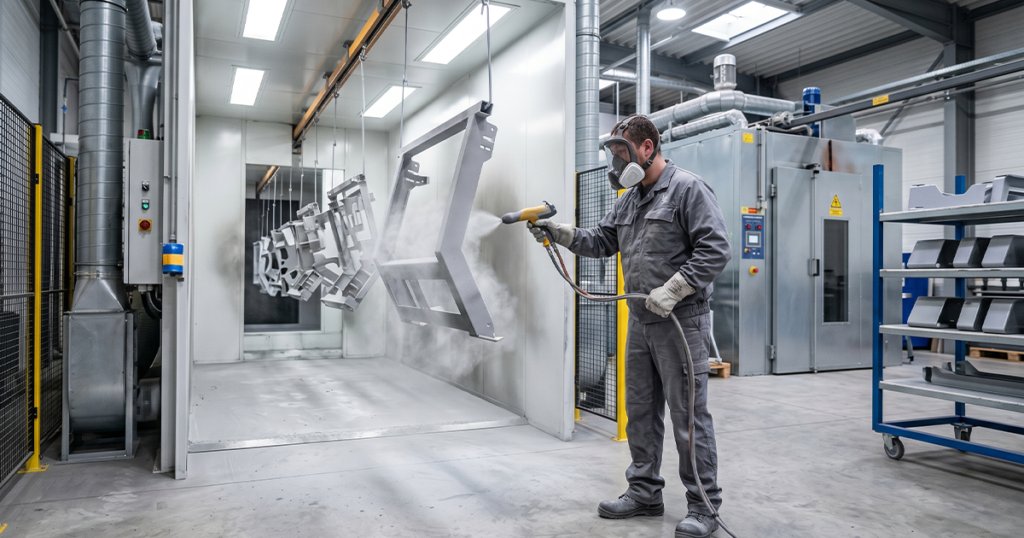
Once the part is prepared and earthed, application begins using electrostatic spray deposition. For components produced as part of precision engineering services, this stage requires particular care. Film thickness and charge consistency directly affect dimensional tolerances on finished parts.
Dry powder is fed through a spray gun that charges the particles as they exit the nozzle. The grounded part attracts those charged particles, drawing them onto the surface and holding them there without any binder.
Two gun types are used depending on the job:
- Corona guns use a high voltage electrode to charge particles. These are standard for straightforward geometries, giving predictable and consistent film build.
- Tribo guns charge powder through friction inside the barrel. Lower charge overall but far better on complex shapes and recessed areas where corona guns struggle with uneven coverage in tight corners.
Standard film thickness runs between 60 and 80 microns for most industrial applications. A coating below this range will not provide adequate protection against wear and corrosion, while exceeding it can introduce internal stress that leads to cracking during or after the curing process.
Because no solvent is involved, there’s no dripping or sagging. The part can be moved to the oven without the coating shifting.
What Happens During the Powder Coating Curing Process?
The part goes into a convection oven at 180–200°C for 15 to 20 minutes. At that temperature, the powder melts, flows into a continuous film and cross-links. The polymer chains bond together permanently.
That cross-linked structure is what gives powder coating its mechanical hardness and chemical resistance. It can’t be reversed. The finish won’t soften under heat or dissolve in water the way some liquid coatings can.
Time and temperature both matter here. Too low and cross-linking is incomplete. The finish looks fine but fails early. Too high and the coating yellows or loses flexibility. Once the part cools, it’s ready to use immediately.
How Long Will Powder Coating Last?
Done correctly on steel or aluminium, powder coating lasts 15 to 20 years under normal conditions. In harsher environments like coastal locations or heavy industrial settings, it shortens but still outperforms liquid paint in most direct comparisons.
The variables that affect lifespan most:
- Surface preparation: The single biggest factor. Poor prep can cause failure within a year, regardless of coating quality
- Powder type: Polyester performs best outdoors. Epoxy offers better chemical resistance but yellows under UV, making it better for indoor or underground applications
- Coat thickness: The 60–80 micron standard exists because thinner coats simply wear faster
- Environment: Salt air, standing moisture and abrasive contact all accelerate wear
Powder coating is one of several finishing options available for engineered metal components. If you’re weighing it against alternatives like galvanising, anodising or wet paint, the guide to types of metal finishing breaks down how each process works and when each one is the right call.
Frequently Asked Questions (FAQs)
What is the powder coating process step by step?
Surface preparation (degreasing, blasting, phosphate treatment), electrostatic powder application and oven curing at 180–200°C for 15 to 20 minutes. Preparation is the most critical stage.
How is the surface prepared before powder coating?
Degreasing, shot blasting to remove rust and scale, a phosphate rinse and in some cases, outgassing to drive out trapped gases before the powder is applied.
How are powder coatings applied?
Using an electrostatic spray gun, corona or tribo type, that charges dry powder particles and directs them onto a grounded metal surface. The charge holds them in place until curing.
What happens during the powder coating curing process?
The part is heated to 180 to 200°C. The powder melts, flows into a film and cross-links chemically. This creates the hard, impact-resistant finish. Temperature and time both need accurate control.
How long will powder coating last?
Powder coating lasts 15 to 20 years under normal conditions when applied correctly. Surface preparation quality, powder type, coat thickness and environment all affect the actual lifespan.