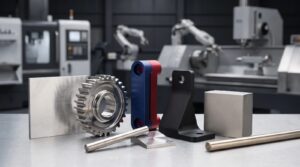
The CNC milling process is a computerised method for manufacturing finished components by providing instructions to milling tools that cut, drill, and shape the parts. The computer-controlled tools precisely and accurately remove excess material from the workpiece. CNC milling work involves creating a digital blueprint or design using CAD (Computer-Aided Design) and turning it into machine code (G-code). Through pre-programmed instructions, the complex component is manufactured, ensuring consistent accuracy and reduced human error.
How CNC Milling Works: A Step-by-Step Guide
To understand the technicality that lies behind the process, you must know how CNC milling works. The step-by-step procedure highlights the consistency, reliability and precision of the process. Here’s what the typical workflow looks like:
- Design the CAD Model
A blueprint or digital design (2D or 3D) is designed by the engineers using CAD software.
- Convert to CAM Instructions
Next, the design is translated into a G-code using CAM software. The resultant code is now machine-readable.
- Material and Machine Setup
The workpiece in question is securely placed on the machine bed with proper adjustment.
- Tool Selection
Based on the operation and requirements, the appropriate CNC milling tools are installed.
- Machining Process
After the setup and complete instructions, the machine removes excess material layer by layer with high precision.
- Inspection and Finishing
The components are measured, assessed and surface-finished. They are also checked for industry standards.
With automated and specialised procedures, resorting to CNC milling service is the smartest decision. Unlike manual milling, it offers improved accuracy and meets the industry-specified standards.
Common CNC Milling Tools Used
Several different types of CNC milling tools are used, depending upon the geometry and material of the component. Some of these include:
- End Mills: Being the most versatile CNC milling tools, they comprise flat, ball-nose and corner-radius cutters.
- Face Mills: Mainly used to machine large, flat surfaces and for smooth finishing.
- Slot Drills: Designed to cut precise slots, keyways and grooves.
- Fly Cutters: Commonly used for finishing large flat areas and smooth surface finishes.
- Drill Bits and Reamers: Used for accurate initial holes.
Choosing the right tool is essential, since it directly impacts manufacturing efficiency and the life of the component.
CNC Milling Materials You Can Machine
CNC milling is versatile, considering it can be used on a variety of different materials. Based on requirements, functionality and cost, the appropriate material is chosen.
Metals
- Aluminium
- Stainless Steel
- Brass and Copper
- Titanium
Plastics
- ABS
- Nylon
- PEEK
- Polycarbonate
Other Materials
- Composites
- Wood
Types of CNC Milling Operations
Several types of CNC milling operations are used when providing precision engineering services, where each of these serves a specific purpose.
- Face Milling: Helps in producing flat surfaces.
- Peripheral Milling: Cuts along the edge of the workpiece.
- Slot Milling: Creates grooves or slots.
- Pocket Milling: Removes material inside a closed boundary.
- Contour Milling: Produces complex 3D shapes.
- Thread Milling: Forms internal or external threads.
Modern, advanced machinery combines multiple operations in a single setup, leading to the production of precise components with tight tolerances.
Application of CNC Milling Machine Across Different Industries
The use of CNC milling machines spans across many industries, including:
- Aerospace: Lightweight and precise parts for aircraft and spacecraft
- Automotive: Helps in producing engine parts, brackets and housings
- Medical: Used to create surgical tools and medical implants
- Electronics: Used for making cases, heat sinks and small components for electronic devices
- Industrial Manufacturing: Used in factories to produce custom tools and machine parts
CNC Milling Advantages and Disadvantages
The CNC milling process has advanced the manufacturing of complex parts and is widely used across distinct industries. However, like every technical method, CNC milling has its own fair share of pros and cons.
Advantages
- Acheives tight tolerances, high accuracy and repeatability
- Capability to handle and work with complex geometries
- Reduced labour costs and fewer chances of human error
- Scalable from prototyping to mass production
Disadvantages
- Higher initial machining and setup costs
- Requires skilled programming and a technical workforce
- Material waste compared to additive manufacturing
It is crucial to take a look at both positive and negative aspects of CNC milling. After weighing the pros and cons, one can decide when CNC milling is the right choice.
CNC Milling vs CNC Turning
CNC Milling and CNC Turning are the two most commonly used machining processes. However, it is essential to understand the key differences between them for a clearer understanding.
- CNC Milling involves removing excess material from a stationary workpiece via a rotating cutting tool. It is best suited for manufacturing complex parts, flat surfaces, slots and holes.
- CNC Turning shapes a rotating workpiece via a stationary cutting tool. The process is perfect for producing cylindrical parts such as shafts, rods and bushings.
With an in-depth understanding of CNC Milling vs CNC Turning, you can simply know the technicalities in a better way. Based on your requirements, the correct process can be chosen. Many manufacturers also use both methods together to create precise and complete components.
Why CNC Milling Remains Essential in Modern Manufacturing
CNC Milling remains at the forefront of modern manufacturing, offering speed, accuracy and precision. Its ability to handle complex components and deliver parts that match industry standards makes it the go-to option for many. Many companies in the UK with expertise and years of experience in CNC milling and related services provide high-quality components that meet ISO standards.
CNC Milling translates CAD designs into finished parts without compromising quality, making it ideal for both prototypes and high-volume batch production. From medical devices to electronics, CNC milling services play a significant role in today’s competitive manufacturing landscape.
Frequently Asked Questions (FAQs)
- What is the process of CNC milling?
CNC Milling is a precision machining process that shapes a stationary workpiece via a rotating cutting tool. It is automated through computerised instructions, where the CAD is converted into machine code (CAM).
- How long does CNC milling take?
The duration of the CNC milling process depends on the complexity, size and material of the required component. Small or single parts can be manufactured in a few minutes, while complex components may require several hours or days.
- What is the difference between manual milling and CNC milling?
Manual milling involves an operator moving the cutting tool to bring about the desired shape and precision. The process is controlled by hand, increasing the chances of human error. CNC Milling is computer-controlled, ensuring fast and accurate results.
- What materials are used in CNC milling?
CNC milling can work on various types of materials, including metals (aluminium, steel, titanium), plastics (ABS, Nylon), composites and wood. Based on your product requirements, functionality and durability, the appropriate material is chosen.
- Where are CNC milling machines used?
CNC milling machines are utilised in almost every industry that requires precise and complex components. Some of them include: aerospace, automotive, medical, electronics and industrial manufacturing.