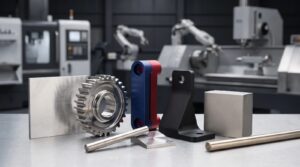
Choosing the wrong machining process doesn’t just cost money. It costs time, rework and sometimes the entire component. Whether you’re sourcing a turned shaft or a milled bracket, understanding where each process genuinely excels is what separates a well-spec’d job from an expensive mistake.
CNC milling and CNC turning are both subtractive machining processes. Material is removed from a workpiece to produce a finished part. The difference lies in how that material is removed, what shapes each process produces and where each one genuinely earns its keep.
What Is CNC Turning and What Is CNC Milling?
CNC turning holds the workpiece in a rotating chuck while a fixed cutting tool removes material. It’s particularly effective for producing cylindrical or conical parts like shafts, pins, bushings and similar components with circular cross-sections.
CNC milling service works the other way around. The workpiece is clamped to a table and remains stationary (or moves on controlled axes) while a rotating multi-point cutting tool removes material. This makes it far more adaptable for complex geometries like slots, pockets, flat surfaces and angled features.
Both processes are computer controlled, which means tolerances are tight and repeatability is high but the applications overlap less than most people assume.
Side by Side: CNC Turning vs CNC Milling
| Feature | CNC Turning | CNC Milling |
| Workpiece motion | Rotates | Stationary (or multi-axis) |
| Cutting tool motion | Fixed/Linear | Rotates |
| Best for | Cylindrical/round parts | Complex, flat or prismatic parts |
| Typical parts | Shafts, pins, threaded components | Brackets, housings, custom profiles |
| Setup complexity | Lower for simple round parts | Higher for complex geometry |
| Surface finish | Excellent on round surfaces | Excellent on flat/contoured surfaces |
| Material removal rate | High for cylindrical stock | Varies by cut depth and toolpath |
This table covers the broad strokes. The nuances matter more when you’re choosing for a specific application.
The Real Difference Between CNC Turning and CNC Milling
The most useful way to understand the difference isn’t process mechanics, it’s geometry.
If your part has a circular cross-section along its primary axis, turning is almost always the right choice. It’s faster for those shapes, produces cleaner surface finishes on round features and generally costs less per part when material removal is straightforward.
If your part has flat faces, angled cuts, complex internal pockets or features that don’t run parallel to a single axis, milling is the appropriate process. A bracket with a bolt pattern. A housing with a recessed channel. A custom plate with irregular profiling. These aren’t things a lathe handles well.
That said, the distinction is becoming less clean. Multi-axis machining centres (4 axis and 5 axis CNC mills) and turn-mill centres can handle both types of work in a single setup. For high volume or complex components, this reduces handling time and improves dimensional consistency across features.
When Should You Choose CNC Turning?
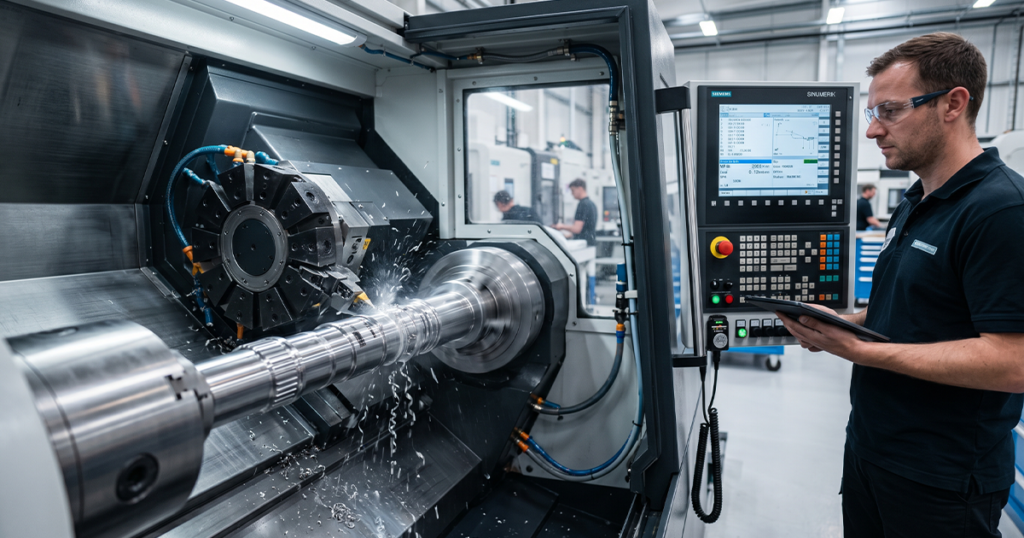
CNC turning service is the stronger option when:
- Your part is predominantly cylindrical, tapered or conical
- You need tight tolerances on diameter and concentricity
- You’re machining threaded components, grooves or knurled surfaces
- Production volume is high and the geometry is consistent
- Material is bar stock (round, hexagonal)
Typical turning applications include hydraulic shafts, bearing journals, turned fasteners and precision pins. In sectors like aerospace, automotive and precision engineering, turning is often the starting point for any round component.
When Should You Choose CNC Milling?
CNC milling makes more sense when:
- Your part has flat surfaces, irregular contours or multiple non parallel features
- You need holes, slots or pockets at specific positions
- The geometry doesn’t lend itself to rotation about a single axis
- You’re prototyping a complex part with several distinct features
- You’re working from a billet rather than round bar stock
Brackets, enclosures, jig components, flanges with bolt patterns and custom tooling plates are typical milling candidates. Milling also tends to be the default for one-off or low volume jobs where part geometry is complex.
CNC Milling vs Turning: Which Is More Expensive?
This is where it gets less straightforward. Neither process is categorically cheaper. The cost depends on part geometry, material, tolerances and batch size.
That said, some general patterns hold:
- Turning is typically lower cost per part for simple cylindrical components in volume production. The setup is faster and cycle times are shorter for those shapes
- Milling can carry higher setup costs because toolpath programming for complex geometry takes more time and tooling requirements are broader
- Material cost often has more influence on overall price than the process itself, particularly for stainless steel, titanium or other high performance alloys
- Tolerances tighten cost regardless of process, achieving ±0.01mm requires more time, tooling and inspection than ±0.1mm
If you’re comparing quotes and one process is significantly cheaper, ask why. Sometimes a job quoted for milling could be redesigned to use turning and vice versa. Experienced machinists will often flag this.
Do You Ever Need Both?
Yes, more often than you’d think. Many real world components combine features that suit turning with features that suit milling. A shaft with a flat keyway. A turned spindle with cross-drilled holes.
For these parts, manufacturers either run two setups on separate machines or use a turn-mill centre that handles both operations in one clamping. The latter reduces cumulative tolerancing error and is worth asking about if your component has mixed geometry.
Our precision engineering services include both processes and our team will advise on the most efficient route for your specific component.
Frequently Asked Questions (FAQs)
What is CNC milling and CNC turning?
CNC milling uses a rotating cutting tool to remove material from a stationary workpiece. It is good for complex, flat or prismatic shapes. CNC turning rotates the workpiece against a fixed tool, making it ideal for cylindrical components like shafts, pins and bushings.
What is the difference between CNC turning and CNC milling?
The core difference is motion. In turning, the workpiece spins while in milling, the cutting tool spins. This determines what shapes each process can produce efficiently. Turning suits round parts while milling suits complex geometry.
When should I use CNC milling instead of CNC turning?
Choose milling when your part has flat faces, slots, pockets, angled features or geometry that doesn’t revolve cleanly around a single axis. If your component looks like it came from a block rather than a bar, milling is likely the better fit.
CNC turning vs CNC milling: which is better?
Neither is universally better. Each suits different part types. Turning is faster and more cost-effective for cylindrical components in volume. Milling is more flexible for complex geometry. The right answer depends on your specific part design.
Is CNC milling more expensive than CNC turning?
Not always. For simple round parts in volume, turning is generally cheaper. For complex, low volume or multi-feature parts, the comparison shifts. Material, tolerances and batch size often matter more than the process itself.