Most guides on this topic list the processes without explaining what actually separates one from another. That’s where the decision usually goes wrong. The wrong finish can mean parts that corrode early, cost you more than they should or simply don’t hold up in service.
Metal finishing treats or coats a surface to change its exterior properties like hardness, corrosion resistance, appearance or conductivity. At a precision engineering company serving mechanical, automotive, and general industry clients, these decisions come up on almost every project. The different types of metal finishing processes aren’t interchangeable and the gap between a good choice and a costly one usually comes down to knowing what each method actually does.
What Different Types of Metal Finishing Actually Do
There are four main types of metal finishes used across mechanical, automotive and general industry work: electroplating, powder coating, anodising and bead blasting. Each addresses a different problem. Here’s what to expect from each.
Electroplating
Electroplating deposits a thin metallic layer onto a substrate by running an electric current through an electrolyte solution. The dissolved metal ions bond directly to the part’s surface, a process also called electrodeposition.
It’s one of the most widely used metal finishing methods because it works across a range of metals and scales well for production volumes. Multi-layer deposits can maximise both strength and conductivity depending on what the component needs.
Common applications for electroplated parts:
- Coins and decorative jewellery
- Sink fittings and taps
- Tin cans, pots and cookware
Zinc plating is one of the more cost-efficient metal finishing options within this category. It provides functional protection from corrosion, abrasion and daily wear without the outlay of more specialised processes.
Powder coating
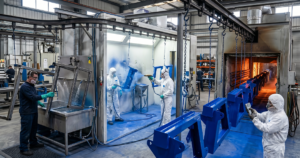
Powder coating is a dry metal surface finishing process. A charged powder made up of pigments, levelling agents and flow modifiers is sprayed onto the substrate, then cured under UV light or heat. The result is a smooth, durable coat that can finish matte, glossy or textured depending on the formulation.
One practical advantage: leftover powder gets collected and reused, which makes it a low-waste process. It also masks minor surface imperfections before the cure sets.
Parts commonly finished with powder coating:
- Lawnmowers and bicycles
- Stoves and refrigerators
- Automotive and agricultural equipment
- Fire hydrants, mailboxes and street furniture
For high-volume applications where appearance and durability both matter, powder coating is hard to beat on cost per part.
Anodising
Anodising is an electrochemical metal surface finishing process. The workpiece is submerged in an electrolyte, typically chromic acid and an electric current drives oxidation on the outer layer. The result is a hard, corrosion-resistant surface that’s bonded to the base material rather than applied on top of it.
It’s used primarily on aluminium, titanium, magnesium and zinc parts. In metal finishing for general industry, anodising tends to appear wherever parts face regular weather exposure or frequent handling.
Typical anodised applications include:
- Handrails and ladders
- Window frames and storefronts
- Bathroom fittings and architectural light fixtures
Where powder coating sits on the surface, anodising becomes part of it. That makes it more appropriate for precision parts where dimensional tolerances matter.
Bead blasting
Bead blasting fires tiny abrasive particles like glass beads, aluminium oxide or similar at a metal surface using compressed air. The impact smooths the surface and produces a uniform matte texture.
It’s worth treating this as a precision step, not a clean-up operation. Bead blasting works as a standalone finish or applied before or after other metal finishing techniques when a specific texture is needed for coating adhesion or visual consistency.
Parts commonly bead-blasted:
- Turbine engine components
- Surgical instruments and orthopaedic implants
- Smartphone housings, laptop casings and vehicle body panels
How to Choose Between Metal Finishing Methods
There’s no single answer that fits every project. The decision depends on the base metal, what the part needs to resist and practical factors like budget and lead time. A comparison by typical use case:
| Finish | Best for | Cost level | Typical metals |
| Zinc plating | Corrosion protection, high volume | Low–medium | Steel, iron |
| Powder coating | Appearance + durability | Low–medium | Most metals |
| Anodising | Precision parts, weather exposure | Medium | Aluminium, titanium |
| Bead blasting | Surface texture, pre-treatment | Low | Most metals |
A few working rules:
- For standard industrial parts in high volumes, zinc plating and powder coating are the most cost-efficient metal finishing options
- Anodising is the right call for aluminium, aerospace-grade applications or anything where the finish needs to hold tight tolerances
- Bead blasting belongs in the process wherever surface texture affects downstream coating or final appearance
The right answer usually comes from working through the specific component, its base material, operating environment and what it needs to survive. Our metal finishing services team does exactly that.
For projects that run from design through to final surface treatment, our precision sheet metal fabrication work integrates directly with any of the finishing stages above.
Frequently asked questions (FAQs)
What are the types of metal finishing?
The main types are electroplating, powder coating, anodising and bead blasting. Each targets a different requirement like corrosion resistance, appearance, conductivity or surface texture. The right choice depends on the base metal, operating environment and budget.
What are the methods of metal finishing?
Metal finishing methods range from electrochemical processes like electroplating and anodising to mechanical processes like bead blasting to coating applications like powder coating. Each produces a different surface result and suits different metals and industries.
Which metal finishing process is most cost-efficient?
Zinc plating and powder coating are generally the most cost-efficient metal finishing options for standard applications. Both scale well for production volumes and don’t require complex process setups. For specialist metals like aluminium, anodising may be cost-effective over the longer term because the finish bonds to the material rather than sitting on top of it.
What is the process of finishing metal?
The metal finishing process follows three stages: surface preparation, application of the chosen treatment and curing or post-treatment. Surface preparation is where most problems either start or get avoided. Inadequate prep leads to adhesion failures regardless of which finish is used.
Can metal finishing processes be combined?
Yes. Bead blasting is often applied before or after other finishes to improve adhesion or achieve a specific texture. Electroplating can involve multiple deposited layers for different properties. Each project is assessed individually. Combined techniques are recommended when they improve the outcome, not as a default.